
While working on RiseMore, we kept returning to a question: if a business can publish on its website, appear in AI answers, join Reddit discussions, and post on social media, what is each activity supposed to achieve?
Listing the channels did not answer it. A business can publish regularly and still struggle to reach customers. It can also attract someone through search who understands the problem but has never heard of the business. Those are different marketing situations.
We knew the channel names before we had a useful way to distinguish those jobs. Learning the terms helped us ask a better question: are we helping someone understand why this matters, or helping someone who is already looking for a way forward?
Demand generation builds interest, familiarity, and preference. Demand capture helps people already looking for an answer or solution find and evaluate your business. Understanding both changed how we think about the work our four agents do. Here is the distinction, where it gets blurry, and how SEO, GEO, Reddit, and Social can work together.
What is demand generation?
Demand generation helps relevant people understand a problem, recognize a useful approach, and become familiar with a business that could help. They might benefit from what you offer without actively searching for it today. Good content gives them a reason to care and remember you.
What are examples of demand generation? A service business could explain a costly mistake its customers often overlook. An e-commerce brand could demonstrate a product in a useful everyday situation. A founder could share a real experiment and what it changed. These are illustrative examples: relevance, evidence, and distribution give each piece its value.
Generating content is a production task. Generating demand involves a change in someone's interest, understanding, or preference. An AI-written post is finished content; whether it reaches the right people and matters to them is a separate question.
Terminology varies. Some marketers use demand generation for the whole program, including capture. For example, Refine Labs' demand philosophy includes creation, capture, and conversion. Here, we use the narrower meaning: building interest and familiarity, alongside work that captures existing demand. This is a useful distinction for planning, rather than a universal naming standard.
What is demand capture?
Demand capture connects your business with people already investigating a relevant problem, comparing approaches, or looking for a provider. They might search Google, ask an AI assistant, or describe their situation in a community. Your job is to offer a useful answer and a clear next step.
Someone searching for a payroll checklist has expressed a need, but may still plan to handle payroll themselves. Someone comparing bookkeeping services is further along. Both can be worth helping; a search query alone does not prove purchase intent.
A relevant guide, comparison page, or thoughtful community answer can help that person evaluate their options. Make the connection to your business understandable: who you help, what you offer, and where they can learn more. In a community, that next step must also respect its rules and the conversation.
The two jobs reinforce each other. Someone might remember a useful social post and later search for the business. Someone who finds a guide might check its author's account before trusting them. Ahrefs describes how search can capture interest created elsewhere. A last click can show where a visit arrived without explaining everything that made the person interested.
How does lead generation fit in?
Lead generation identifies potential customers and creates a way to follow up, often by collecting contact details. Demand capture describes responding to relevant demand already being expressed. A useful search guide followed by an enquiry form can do both. An online store can capture demand through a direct purchase without asking the customer to become a sales lead first.
Ahrefs explains the distinction using content and lead-capture examples. An email address creates an opportunity to follow up; you still need to learn whether that person has a problem your business can help solve.
A channel can do both jobs
Our first temptation was to label SEO, GEO, and Reddit as capture, and Social as generation. That is a reasonable starting point for some activities, but it becomes misleading as a rigid classification.
A search article can answer an immediate question while introducing an approach the reader had never considered. A Reddit comment can help someone already seeking advice; a useful community post can introduce an overlooked problem. A LinkedIn post can build familiarity or answer a question someone is actively researching.
Ask what the person needs at that moment, how they will encounter the content, and what it should help them do next. Those questions are more useful than assigning a permanent label to the platform.
For your next piece of content, write down who it is for, whether they are already seeking help, and what useful next step it offers. Explaining an unfamiliar problem can build interest; answering a specific comparison can serve existing demand. The same piece may contribute to both.
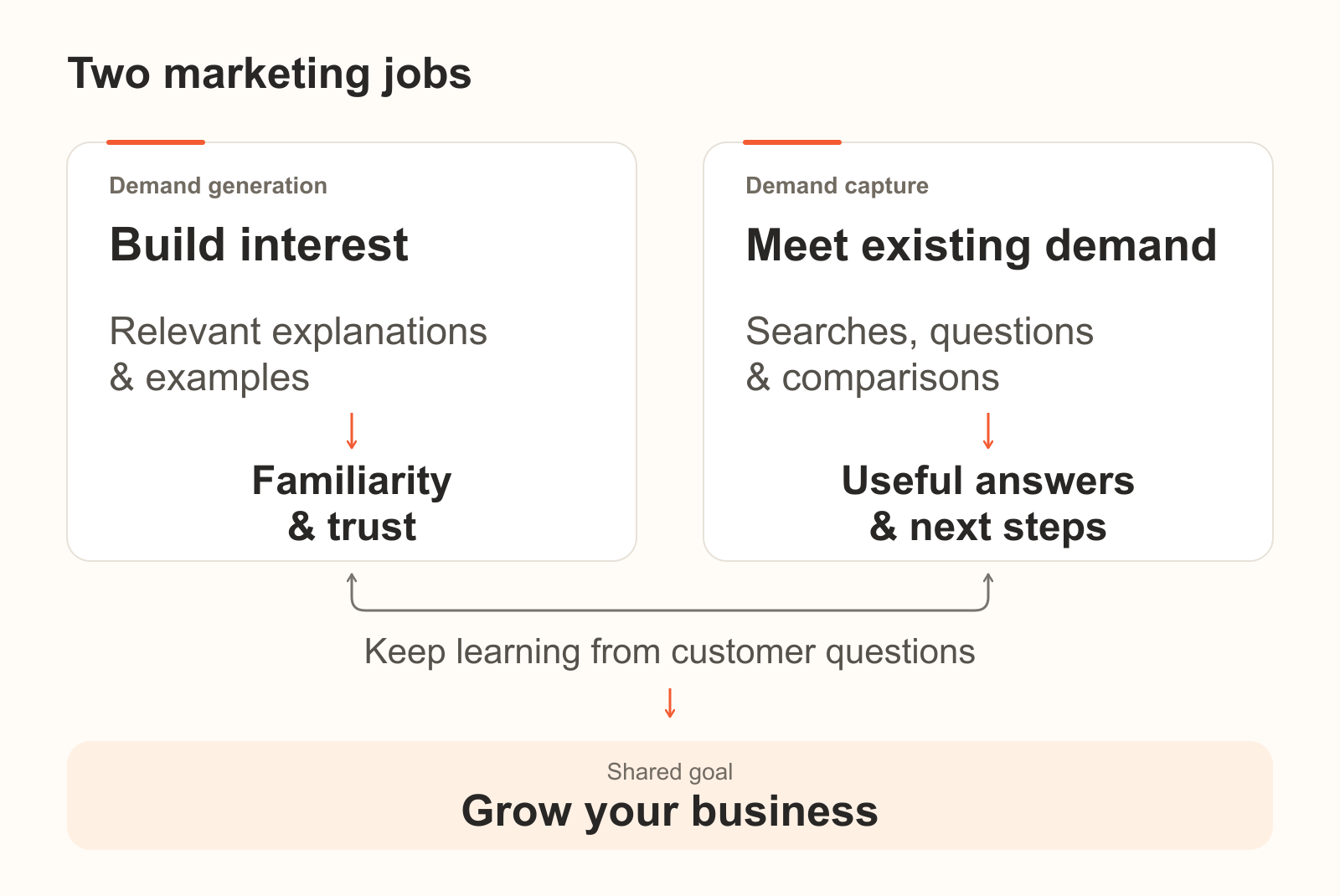
How both work for the same business
Consider an illustrative example: a bookkeeping practice helping small shops hire their first employee.
To build interest, it could share a clear explanation of what changes when a shop becomes an employer. An owner who has not started preparing might recognize a task they need to plan for, remember the practice, or save the explanation for later.
To capture existing demand, the practice could publish a first-payroll guide based on verified requirements and customer questions. It could also contribute useful advice in a relevant discussion where professional participation is welcome. Here, the reader has already raised the problem.
The subject overlaps, but the context and next step differ. One explanation makes a future task easier to recognize; another helps someone deal with it now. A store selling products or a software company can apply the same reasoning to its own customers' decisions.
Where should you start?
Start with evidence of what customers need and a place you can realistically reach them. If relevant searches and discussions already exist, answering them gives you a concrete starting point. Check the competing answers, business fit, and next step before investing in content.
If people do not understand the problem or your approach, education and demonstration may need more attention. An established audience, a new product, a short buying cycle, and a long purchasing process create different needs. There is no fixed budget split or timetable that fits them all. Keep learning from customer conversations while improving the places people land.
Existing search demand does not remove the need to build familiarity and trust. Someone can find your page and still need to understand why your business is relevant and credible. Earlier content can also influence what they search for later. As you grow, use what customers actually do to adjust the work, instead of treating generation and capture as stages you graduate from.
How RiseMore's four agents help with both
RiseMore is your AI marketer, with four agents for SEO, GEO, Reddit, and Social. They learn about your business, products, services, and audience, then carry research and writing through to publication and supported performance tracking. Their shared goal is to help grow your business by reaching customers, building visibility, joining relevant conversations, and earning trust. You review the prepared content and confirm its publication details.
Each contributes differently. You can start with the work that fits your business; using all four at once is not a requirement.
SEO Agent: help people find useful answers on your site
SEO Agent researches search demand and intent in the context of your business. You choose a proposed article topic, it creates the article and cover for publication to your connected WordPress site.
For the bookkeeping practice, that could be a first-payroll guide, after checking the relevant searches and local requirements. This often supports demand capture: someone searches for a problem or approach, and your page helps them make progress. An educational article can also introduce a need or explain a better way to handle it. The writing needs to serve that reader and connect to your business where it helps.
With Google Search Console connected, you can inspect queries, pages, impressions, clicks, and average position. Use those observations to improve the pages and questions attracting relevant readers. Our keyword research walkthrough follows the process from choosing a relevant question to checking the published article.
GEO Agent: build your presence where people ask AI for help
GEO Agent researches questions your business can help answer and develops article briefs. From your chosen brief, it creates an article and cover. Managed publishing on your behalf currently supports Medium and DEV.to.
The practice could research what shop owners ask when choosing payroll help, then develop an article around the questions and findings. This puts buyer questions at the center of the work. A question comparing solutions may signal existing demand; an explanatory question may be part of learning about a need. Useful public information can support both situations. Publication makes that information available beyond your own site. AI engines independently choose what to mention or cite.
GEO also lets you inspect saved AI answers, brand mentions, and citations across dated observations. A published article, an AI mention, a citation, a visit, and a customer are different results. The AI visibility tracking guide explains how to read the evidence without assuming one caused another.
Reddit Agent: contribute where a relevant conversation is happening
Reddit Agent researches communities, threads, existing answers, and rules. A selected thread opportunity leads to a comment answering the original post; a community opportunity can lead to a standalone post. RiseMore publishes the confirmed content on your behalf.
For that practice, an owner's specific hiring question would call for a relevant answer; a broader community post could explain an overlooked preparation step. Answering a specific, unresolved question can help capture demand. A useful community post can also introduce an idea or make a business familiar to relevant readers. Both depend on contributing something the discussion needs. Finding a relevant thread does not give a business permission to promote itself.
Open the publication link to inspect the result and actual conversation. Community moderation and reader responses determine what happens next, so staying relevant after publication matters too.
Social Agent: keep giving relevant people a reason to remember you
Social Agent uses business updates, research, and community activity to develop topics and write posts with images for your own X and LinkedIn accounts. Content follows each account's voice and context. Approved posts publish through the connected account on its schedule.
The practice could share a short explanation of a common misconception, backed by its expertise, that a shop owner remembers before they need help. Its main contribution is familiarity and trust over time: explaining useful ideas, sharing real progress, and giving relevant people something worth responding to. It can also address questions people are researching and distribute content that helps them evaluate your business.
RiseMore currently collects engagement metrics for X; inspect LinkedIn engagement on LinkedIn itself. Treat reactions as feedback about the content and audience, then look separately at whether people take a meaningful next step.
Connect the work, then measure the right progress
A real customer question can inform a search guide, a buyer-question article, a community contribution, and a social explanation. Give each piece a useful angle and an appropriate destination. Shared business knowledge and related research help the work stay coherent as you build a body of published content.
For capture, inspect how people find the answer and what they do next: relevant visits, enquiries, registrations, or purchases in your own analytics. For generation, also watch whether relevant people return, search for your brand, or tell you they remember the work. Those signals can be useful without proving that one post caused a conversion.
Cognism's B2B measurement approach separates early signals from commercial outcomes. Your measures will depend on your business, but the practical lesson travels: judging every activity only by its immediate last-click conversion leaves part of the story out. Commercial results still matter for the overall work.
Pick one customer need you can explain, one useful piece of content, and one appropriate place to publish it. Learn from the response and build from there. Explore RiseMore's four agents to see how your AI marketer can carry that work forward.