65% of CMOs believe AI will dramatically change their roles within two years. Only 5% of marketing leaders using generative AI solely as a tool report significant business outcome gains.
The gap between those two numbers — 60 percentage points — is the most important marketing stat of 2026. And it has nothing to do with model quality.
The Tool-Only Trap
Gartner's 2025 CMO survey surfaced the 65% number. McKinsey surfaced the 5% number in their AI maturity research. Together, they tell a story that most AI marketing vendors don't want you to hear: buying an AI tool and using it as a prompt box is a dead end.
McKinsey found that AI high performers — the teams getting real business outcomes — are nearly three times as likely to fundamentally redesign workflows and scale AI agents. They're not just adding AI to existing processes. They're rebuilding the processes around what AI agents can do.
This is the difference between AI-as-tool and AI-as-infrastructure. A tool waits for your prompt. Infrastructure runs while you sleep.
The 7-Layer AI-Ready Marketing OS
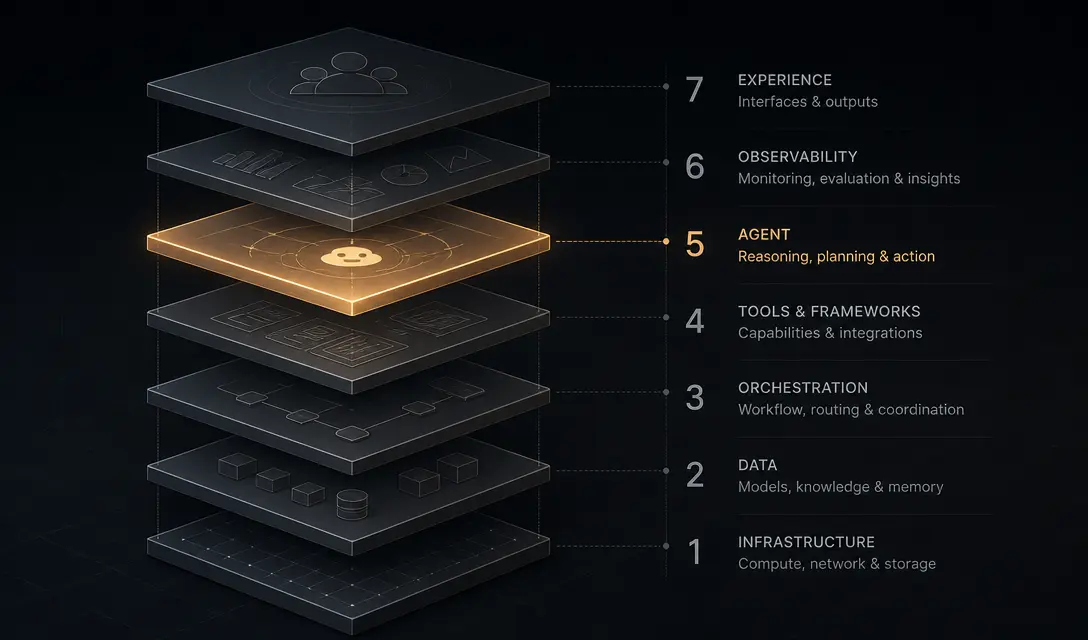
MarTech.org published a framework in July 2026 that maps what an actual AI-native marketing operating system looks like. It has seven layers:
Layer 1: Workflow — The orchestration layer. How work moves from signal to output to measurement without a human manually handing off each step.
Layer 2: Data — Unified customer and performance data. Not 14 disconnected tools with conflicting numbers.
Layer 3: Content/Assets — Brand-governed content that maintains voice consistency across channels. The 90%-to-64% consistency gap between governed and ungoverned AI content lives here.
Layer 4: Governance — Brand rules, compliance, approval gates. The layer that prevents AI from scaling brand inconsistency at machine speed.
Layer 5: Agent — This is the novel addition. Systems that deploy agents to draft briefs, generate content variations, check assets against brand rules, summarize performance, recommend next actions, and trigger follow-ups. The agent layer is what makes it an OS rather than a collection of tools.
Layer 6: Orchestration — Cross-channel coordination. Making sure the blog post, the LinkedIn thread, and the X posts aren't contradicting each other.
Layer 7: Measurement — Unified analytics that close the loop from execution back to strategy. The 81% of marketing teams that lack AI-specific KPIs fail at this layer.
Why Layer 5 Changes Everything
The first four layers existed in Marketing OS 1.0 — the campaign-centric, human-driven model where a marketing manager manually coordinated tools, data, content, and governance. What's new is Layer 5: the agent layer that runs the loop without a human approving each individual step.
This is the shift from "I use AI to write faster" to "AI runs the marketing workflow and I approve the direction."
For enterprise teams, this means Salesforce Agentforce or Adobe GenStudio — systems that cost $400K to $1.2M annually and require 8-12 ML engineers to deploy. For solo founders and bootstrapped teams, it means platforms like RiseMore that embed the same architecture — product context → agent layer → content engine → publishing — at a price point that doesn't require a funding round.
The 60-Point Gap, Explained
The reason 65% of CMOs see AI transforming marketing but only 5% of tool-only users get real results is simple: most teams stopped at Layer 3. They bought an AI writer. They didn't build the agent layer that makes everything else run.
An AI writer without workflow is just a faster way to produce content nobody sees. An AI writer without governance is a faster way to produce content that sounds like everyone else. An AI writer without measurement is a faster way to burn budget with no way to prove it worked.
The 60-point gap closes when you stop treating AI as a faster typewriter and start treating it as an operating system layer that runs the loop: signal → decision → creation → distribution → measurement → next signal.
What This Means for Solo Founders
The 7-layer framework wasn't written for solo founders. It was written for enterprise CMOs managing 14-tool stacks and eight-figure budgets. But the architecture is the same at any scale.
A solo founder needs the same seven layers. They just need them in one connected system that doesn't require a team to operate. Product context replaces the data layer. Brand voice configuration replaces the governance layer. An AI agent that learns the product and decides what work matters next replaces the workflow and agent layers. Approval-first publishing replaces the orchestration layer.
That's the bet behind every AI-native marketing platform being built in 2026. The ones that win won't be the ones with the best prompt box. They'll be the ones that actually close the 60-point gap.