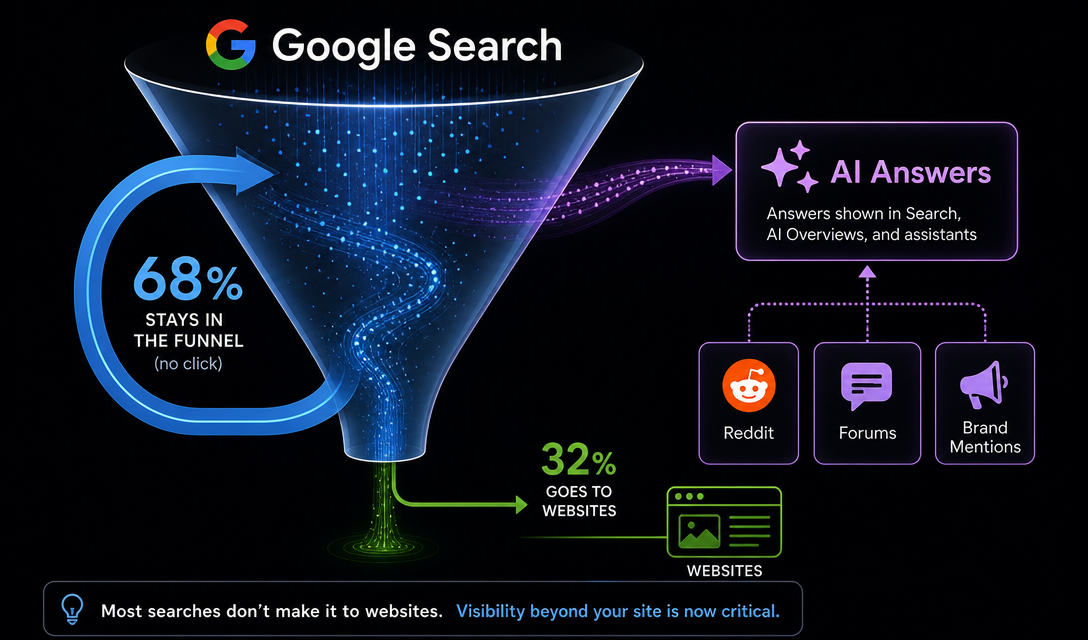
Content marketing for SaaS, run by one person, is mostly a scheduling problem. If you are the whole marketing team, you have maybe three hours a week, and there is no version of the next two quarters where you out-publish anyone. The data sides with your calendar: of a million URLs found that 1.74% of newly published pages reach Google's top 10 within a year, while 72.9% of the pages already sitting there are more than three years old.
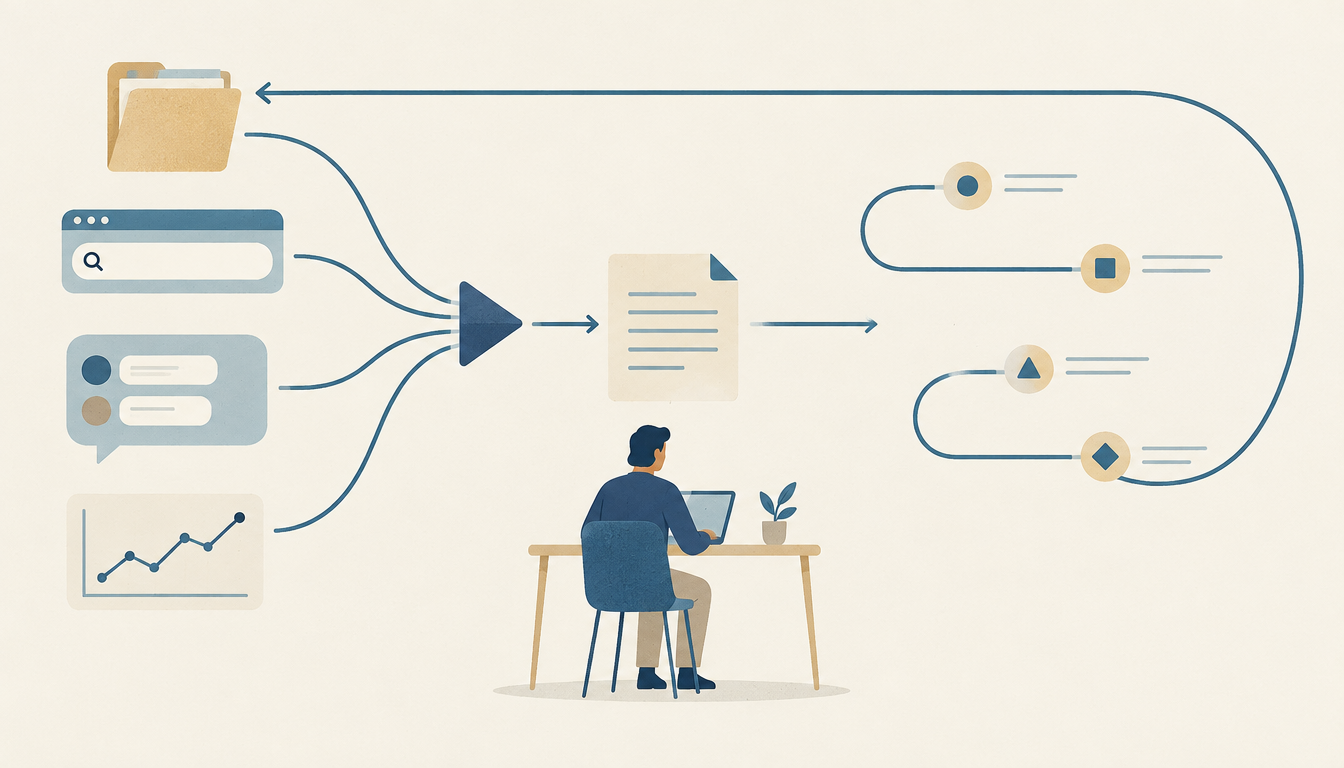
What you can build instead is a small system: a queue that decides what is worth writing, a loop that gets the piece out in the hours you have, and a habit of feeding every published page into the next one.
A SaaS Marketing Strategy Is a Queue, Not a Channel List
Most advice on a SaaS marketing strategy arrives as a channel menu: blog, LinkedIn, X, newsletter, podcast, paid. A menu is useless when you can pick exactly one thing this week. The real decision is narrower and harder: which single piece of work matters most right now, given what your buyers are asking and what your competitors have already covered.
of just over 1,000 content marketers makes that narrower choice easier to defend. 92% of them now use AI for blogging, and in Orbit's data that use correlates with nothing: AI users and non-users report strong results at the same rate. What does correlate is work that needs judgement. Publishing original research improved the odds of strong results by 50%. Marketers who collaborated with people outside their team beat the benchmark by 2.6x. Human editing, keyword-aware long-form, and two or three visuals per post all correlate with performance as well.
Adoption of nearly all of those practices is falling. The average post is now 1,312 words and 3 hours 20 minutes to write, and only 13.9% of marketers say their blog delivers strong results, an all-time low in twelve years of the survey. That leaves an opening for one person: the work that correlates with results is the work teams are abandoning, and four of those practices, done slowly, fit inside a founder's week.
How to Market a SaaS Product With Three Hours a Week
Treat it as a loop you run repeatedly rather than a campaign with a start and an end. Pick the one or two surfaces where buyers already describe the problem in their own words: search, one or two communities, and the messages sitting in your support inbox. Then write one substantial answer per cycle, and put every piece through the same five steps, so deciding never happens while you are already doing.
A week that fits in about three hours:
- Decide, 30 minutes. Reread the queue: the queries your site already shows up for in Search Console, the thread where the question was asked this week, the competitor page you noticed. Pick one, not three.
- Draft, 90 minutes. Start from what you have already stored about your product, plus the one specific input for this piece: a support ticket, a launch note, a customer's own wording for the problem. Not from a blank page.
- Edit and approve, 20 minutes. Cut the warm-up, keep the number, keep the example, publish.
- Distribute, 40 minutes. Answer the community thread where the question already exists, post on the channel where your buyers actually spend time, and add one internal link from the nearest older page.
- Save the leftovers. The quote, the metric, and the objection you could not answer go into a materials file. The next cycle's draft starts there.
That is under three hours, and it will not feel like marketing. What kills it is not a bad post: it is five good posts in one enthusiastic week, then silence for two months. A burst feels productive, which is how most solo content programs end up with five posts and nothing since.
What Has to Exist Before the First Draft
Four things, each one removing a specific way the work dies.
- Product context. Positioning, who you are for, who you are against, and the phrases buyers use for the problem. Without it, drafts come back generic and you spend your three hours rewriting them into your own voice.
- Saved materials. Launch notes, metrics, customer stories, competitor moves, and the support ticket that explained the problem better than your landing page does. The specific details that make a piece worth reading come from here, not from a model.
- Search data. Which queries your pages already appear for, which questions have demand, and which pages sit three positions away from page one. Orbit's numbers point the same way: keyword-aware content correlates with performance, and fewer marketers do it every year.
- A publishing surface you own, with an approval step. Your blog, plus the one or two channels where your buyers are. Nothing goes out that you have not read.
This is the layer RiseMore is built for. It reads your URL and description to build product context, keeps a materials library of launches, metrics, customer stories and competitor moves, and runs the queue with you: it suggests what to write next, drafts in your voice, and waits for your approval before anything reaches a connected channel. The deciding and the storing are the parts a solo founder usually loses first.
The Cadence: One Deep Piece, Kept Alive
Orbit's earlier surveys kept finding the same correlation: marketers who spent six hours or more on a 2,000-word post roughly doubled their odds of strong results. In 2026 the industry average fell to 3 hours 20 minutes per post, and the share reporting strong results fell with it. Those six hours go mostly into inputs: the interview, the number, the screenshot. That is also why a faster drafting tool does not close the gap on its own.
The solo version is one substantial piece every two or three weeks, plus a monthly pass over what you have already published. Ahrefs found that 40.82% of the pages that eventually reached the top 10 did so within a month of publication, and that after about six months without a top-10 position you should be updating the page rather than waiting on it. So the cadence runs at two speeds: new pieces for questions nobody has answered, and revisions to pages that are close.
Counted across a month that is closer to four hours a week than three, because the update pass takes an hour of its own. For scale, the average content marketer in Orbit's survey publishes 57 posts a year. You will publish closer to twenty, which is fine as long as the twenty are questions your buyers type into a search box.
How the Work Compounds
Compounding here has four mechanics you can point at.
- Pages age into rank. The average #1 result in Google is five years old, so the page you publish this quarter is one of the few assets you own that gets better at its job with no further work from you.
- Internal links. A tenth page makes the first nine easier to find, but only if you link them on purpose.
- Reuse. A customer story, a metric, a teardown of a competitor's pricing page keeps paying after the piece it first appeared in, because it becomes the specific detail inside three later posts.
- Quotable answers. A page that settles one question in its first two sentences is easier for an answer engine to lift intact. Orbit's survey notes that AI tools now run searches on buyers' behalf, and that content easy for machines to retrieve performs better.
The ceiling on all of it is your choice of questions. of roughly 14 billion pages found that 96.55% of them get no estimated organic traffic from Google at all, and the first reason listed is that the topic has no search demand. Twenty questions people actually type will do more for a product than two hundred pages nobody asked for.
What This System Doesn't Fix
Content will not manufacture demand. If your category has no search volume and no community where the problem gets discussed out loud, more pages will not create buyers, and the three hours belong to outbound conversations or to repositioning against a category that already exists.
It also does not pay this month. The pages ranking for your terms were mostly published years ago, so what you write this week is a deposit. If your runway is short enough that you need revenue in 60 days, spend the hours on sales conversations and come back to this later.
And it keeps you in the loop, deliberately. You still read every draft before it goes out. That approval step is the reason the published writing can sound like you instead of like the average of the internet.
Start With the Questions You Already Have
Write down the ten questions buyers asked you in the last month, in their words rather than yours, and put them in priority order. Answer the cheapest one properly this week. Then put the same appointment in next week's calendar, because the second piece is where most solo content systems die.