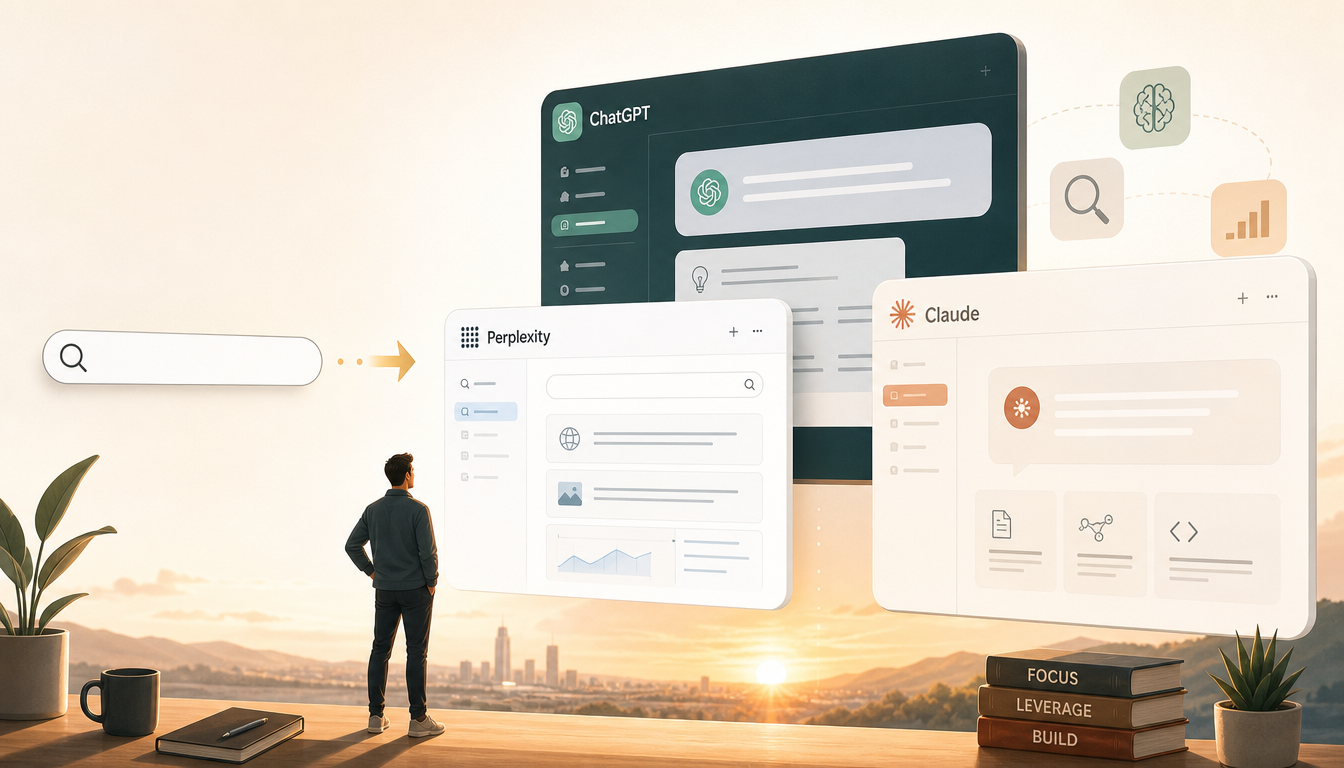
If you're a solo founder, the way people find products is already changing. They're not just Googling anymore. They're asking ChatGPT, Perplexity, Claude, and Gemini. And those AI platforms are answering — often without ever sending anyone to your website.
A new survey from AMP Marketing and PR found that 44.7% of marketing leaders currently have no AI search strategy. None. Meanwhile, 50.9% say traditional SEO is being replaced by AI-driven discovery, and 35.2% are shifting budget toward AI visibility — ahead of paid media, PR, and traditional SEO.
If nearly half of marketing leaders are doing nothing while the discovery landscape is being rebuilt, that's not a crisis. That's a window.
Cara Milan, CEO of AMP, put it bluntly: "The people and companies that move first will have a significant advantage in shaping the answers clients and customers receive. Those who wait may find that AI has already written their story for them."
This article is for the solo founder who doesn't have a marketing team, doesn't have a budget for an AI search consultant, and doesn't have time to become an expert in generative engine optimization. Here's what you actually need to do.
What AI Search Actually Looks Like in 2026
Before we talk strategy, let's get clear on what's happening. AI search isn't one thing — it's a collection of answer engines that surface information differently than Google does.
When someone asks ChatGPT "what's the best project management tool for a solo developer," the AI doesn't return ten blue links. It returns an answer — often citing specific products, features, and comparisons. The sources it cites become the winners. The sources it ignores become invisible.
The same dynamic plays out on Perplexity, Claude, Gemini, and the AI Overviews Google now shows above organic results. The unit of competition has shifted from ranking for a keyword to being cited in an answer.
This changes everything about how you think about visibility. You're no longer optimizing for a search engine algorithm. You're optimizing to be the source an AI trusts enough to cite.
Step 1: Audit How AI Platforms Describe You Right Now
Before you build a strategy, you need to know your starting point. Ask each major AI platform a simple question: "What is [your product]?" or "What does [your product] do?"
If the AI doesn't know your product exists, that's your baseline. If it describes you inaccurately — wrong category, wrong features, outdated pricing — that's a problem you can fix. If a competitor is cited instead of you when someone asks about your category, you know exactly where the gap is.
Do this for ChatGPT, Perplexity, Claude, Gemini, and Google AI Overviews. Document what each platform says. This is your AI visibility baseline.
Step 2: Get Cited Where AI Platforms Source Their Answers
AI answer engines don't invent information from nothing. They pull from sources they've been trained on or can access in real time. The question is: are you in those sources?
The most commonly cited sources in AI answers include:
- Reddit and community forums, because AI platforms heavily weight authentic discussions where real users describe real experiences.
- Well-structured documentation and FAQ pages, because clear question-answer formats are easier for AI to parse and cite.
- Industry publications and credible blogs, valued as authoritative sources with clear bylines and specific claims.
- Product review and comparison sites like G2 and Capterra, which feed directly into AI recommendations.
- YouTube transcripts, since AI platforms increasingly cite video content when it contains detailed, specific information.
For a solo founder, the most accessible entry point is community presence and structured content. If your product is genuinely discussed on Reddit with specific, helpful details, AI platforms are more likely to surface those discussions. If your documentation clearly answers the questions people ask AI, those answers become citeable.
Step 3: Build Content AI Can Actually Use
Not all content is equally citeable. AI platforms prefer specific claims over vague positioning. "Our project management tool helps teams" is useless to an AI. "Our project management tool handles dependency chains across 50+ concurrent tasks without manual rescheduling" is citeable.
They prefer structured information over narrative prose. FAQ pages with clear question-answer pairs, comparison tables with specific features, and step-by-step guides with numbered instructions are easier for AI to parse and reference.
They prefer attributed sources over anonymous claims. When you cite research, name the source and date. AI platforms weight attributed information more heavily than unattributed claims.
And they prefer consistent information across platforms. If your product description says one thing on your website, another on your LinkedIn, and something else on G2, AI platforms receive conflicting signals. Consistency across every surface where your product appears is a ranking factor in AI search.
Step 4: Make AI Visibility Someone's Job
Cara Milan's survey found that 66% of marketing leaders consider AI search visibility an immediate priority or one to address within six months. But priority without ownership is just anxiety.
For a solo founder, "someone's job" means your job — but it doesn't mean you need to do it manually. The key recommendations from the AMP report are:
- Audit regularly: check how AI platforms describe your product at least monthly.
- Assign ownership: even if it's you, treat AI visibility as a defined responsibility.
- Integrate rather than silo: your PR, content, SEO, and community presence all feed AI visibility — treat them as inputs to the same system.
- Monitor AI-generated brand narratives: if an AI platform starts describing your product inaccurately, that's the story potential customers are hearing.
The Window Is Open. It Won't Stay That Way.
The 44.7% of marketing leaders with no AI search strategy won't stay at zero forever. The 35.2% shifting budget toward AI visibility is only going up. The window where moving first creates a real advantage is measured in months, not years.
But for a solo founder, the bar is lower than you think. You don't need an enterprise AI search strategy. You need three things: know what AI platforms say about you, make sure you appear in the sources they cite, and build content structured for AI consumption.
The founders who do this now will shape the answers customers receive. The ones who wait will find those answers were written without them.