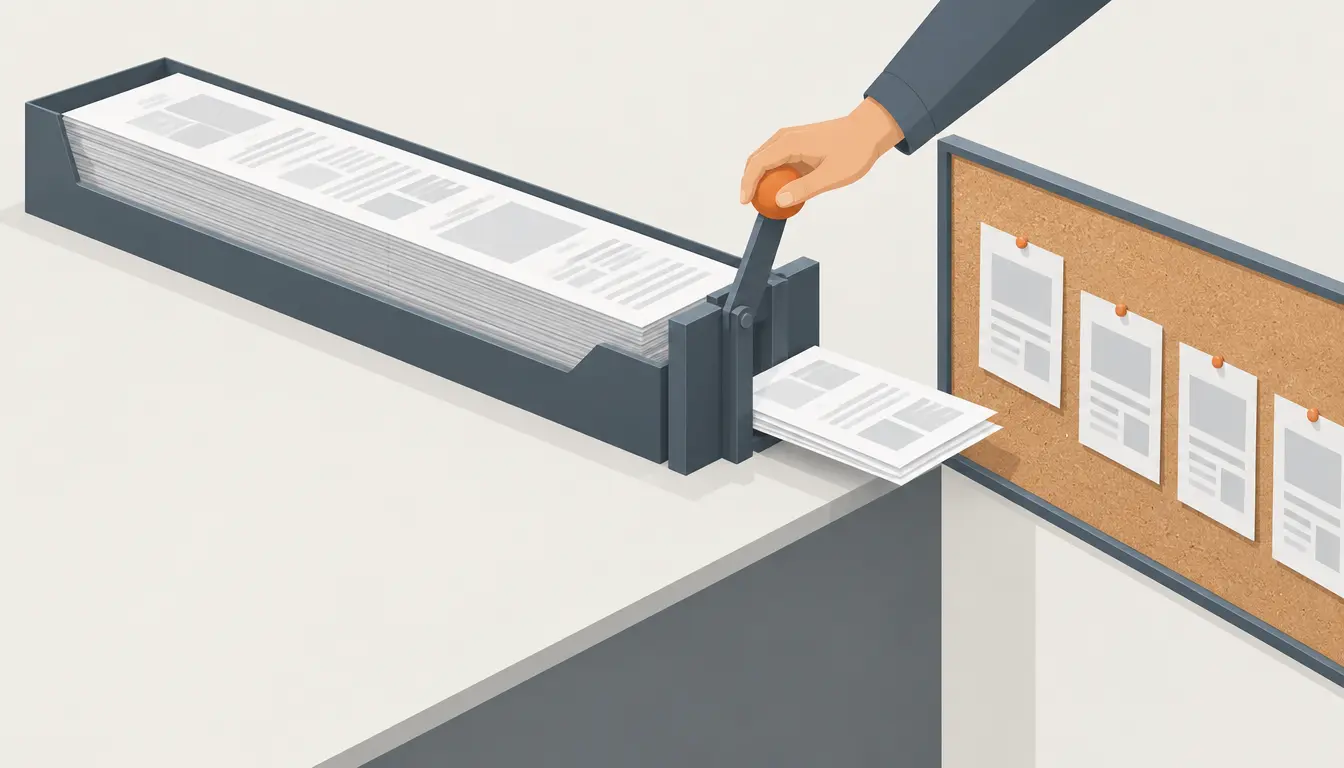
Vibe marketing is the practice of pointing AI agents at the research, drafting and testing that used to consume a marketing team's week, while a person keeps the decision about what actually ships. Nearly all of the finding and the writing is now available to one founder with a product and no marketing hire. The part worth refusing is the version sold as set it up and let the agents run, where the publishing decision leaves with the labor.
The term is about eighteen months old and carries four incompatible definitions. The statistics attached to it mostly do not survive a source check, and the man who coined the phrase it borrows from has retired that phrase. Knowing which parts of it are load-bearing is the difference between adopting a workflow and adopting a posture.
What "vibe marketing" means depends on who is selling it
Andrej Karpathy posted "vibe coding" on X on 2 February 2025, with a rule that came to define it: describe what you want, accept what comes back, do not read the diff. Seven weeks later, on 22 March 2025, the investor Greg Isenberg applied the idea to marketing and credited James Dickerson with the workflows behind it. A Forbes contributor carried it to a mainstream masthead within days, and the sourcing gets looser from there. traces the whole chain.
The definition with the clearest writing behind it came from MarTech later that year: "Vibe Marketing is machine-accelerated creativity. Humans translate intentions into outcomes using AI as an accelerant." The adds that these systems "don't replace human judgment; they amplify it."
By then the phrase had split into at least four meanings. The workflow definition above. An emotional definition that Salesforce uses, which is about building a feeling around a brand and has no AI in it at all. A vendor definition that routes every explanation toward one product. And an operating-model definition from Hightouch, which argues most of what gets called vibe marketing is really marketing automation, and that the version which compounds needs customer data and a brand context layer.
Read that last one twice, because Hightouch sells the thing it is describing: it publishes guides to vibe marketing while describing its own product as an "Agentic Marketing Platform." Most people defining the term are selling into it, which is why none of the definitions has won. There is no dictionary entry and no analyst definition. Gartner's Hype Cycle for Digital Marketing, published in July 2026, describes the same shift as autonomous marketing and uses the word agentic. eMarketer reported in November 2025 that marketing leaders had not settled on an exact definition while still expecting the shift to matter.
The clearest evidence of the split is in job ads. Revamp, a Y Combinator company, advertised a part-time fractional "Vibe Marketer" that turned out to be a culture-first social role with no AI workflow in it. Sendbird, on the same board, advertised an AI-First Full Stack Marketer asking for Claude Code and Cursor experience under a title that never uses the word.
Karpathy himself replaced "vibe coding" with "agentic engineering" in February 2026, and the reason is the useful part. Vibe coding meant accepting output you had not read, which he had already called fine for throwaway weekend projects. Agentic engineering means designing the system and specifying the constraints. You can agree with both halves of that: the word "vibe" tells you nothing about whether a tool is safe to leave running.
The statistics have travelled further than the evidence
Three numbers are quoted so often that they read as background. That 47% of Fortune 500 companies have adopted vibe marketing. That it cuts content production costs by 70% to 80%. That it delivers 60% faster revenue growth. None of them resolves to a study, a sample or a method, and the 47% claim is dated to a period before the term existed.
The nearest real research to the revenue claim is McKinsey's work on personalization, which found faster-growing companies draw around 40% more of their revenue from it. Different number, different claim, different subject. went looking for the same figures and reported the same dead end.
The growth statistic that has a publisher behind it is stale rather than invented. MarTech's manifesto quotes Exploding Topics putting searches for the term up "nearly 700%" in the year to mid-2025, from about 1,000 to 6,500 a month. SaaStrix pulled US volume from Ahrefs on 12 September 2026 and got 386 searches for the month, down roughly 89% from a peak of 3,393 in May 2025. The keyword data tracked for this site lists 590 US searches for the same month. Either way, it is hundreds, not thousands.
Two checked numbers are worth more than the three invented ones. Exploding Topics surveyed 1,008 US marketing budget decision-makers and published in April 2026; 60.12% of marketing teams had grown headcount over the previous twelve months, against 8.9% that had shrunk. The claim that one marketer now replaces ten is not showing up in the hiring. And an audit that went looking for a named case of a single marketer producing the promised outcomes under this label found nothing that survived checking. Recorded demonstrations exist in which one person builds research, positioning, copy and a landing page inside a single session. The workflow is clearly executable by one person. Nobody has published what it earns.
Where the line belongs for a one-person company
The scarce input in a one-person marketing operation is not writing speed. It is knowing which questions buyers actually ask and which claims about your product are true. Awesomic's guide states the first half better than most: write your voice as constraints rather than adjectives, because "second person, contractions on, no superlatives, name the number" is usable by a model and "confident and approachable" is not.
Run that through a solo founder's week and the work splits into four decisions.
| The decision | Where it should sit |
|---|---|
| Which questions to answer | Agents, starting from your product context and the buyer questions saved in it |
| The first draft, in your voice | Agents, writing against constraints you wrote down |
| Whether the claim is true and the destination allows it | You |
| Whether it goes out, and when | You, by approving it |
The last two rows are what the slogans drop. The MarTech manifesto, which defines the practice carefully in one section, tells its reader in another to "set aside your ego" and ship before the RFP is approved. Vibe coding's original rule was to write code you did not read, and its author walked it back for exactly this reason. A marketing workflow that keeps that posture is an unreviewed publishing machine.
There is a test worth applying to any tool in this category before its first month is up: read what it says it cannot do. RiseMore's own documentation states that AI visibility measures the share of valid answers mentioning your product and not visits or sales; that a mention is not a recommendation and a citation does not guarantee someone visits; that publishing an article does not guarantee indexing or a ranking; and that the SEO agent will not silently rewrite pages you already have. Those are the promises the rest of the market makes quietly. A tool that declines to make them is telling you where its part of the job stops, which is the information you need to hold the last decision.
What the approval step is buying you
In June 2026, The Harris Poll, the 4As and Infillion presented research at Cannes Lions that should sit next to every automation decision this year. , 73% said they would be less likely to trust an ad they suspected was AI-made, and 63% said they would be less likely to buy from a brand that uses AI-generated ads. More than two-thirds see AI as a marketing ploy, and the same share find brands cringey when they over-use it.
Harris' reading of its own numbers is the part the tool-buying guides skip: stamping "AI-powered" on your marketing "signals nothing, and it may cost you," while the brands that earn consumers' confidence will be the ones that are clear about where AI ends and human judgment begins.
The published failure cases have a single shape.
The failure is never that the AI wrote badly. It is that nobody with context saw the output before a customer did.
Awesomic's guide says that, and cites one example with consequences attached: an IT team leader sending AI-written marketing materials to medical professionals and patients, past the review process, from someone who did not know the product basics. One anecdote, but the pattern is the transferable part.
For a one-person company the cost is sharper than for a brand, because there is less audience to absorb a bad week and fewer channels left to earn it back in. The community you post to once a week is also the likeliest place for an unreviewed draft to land badly. RiseMore's Reddit agent publishes only to a community or thread the user confirms, and its documentation says plainly that publication must respect the target community's rules. Founders selling into merchant communities have described the other outcome themselves. One, writing in an Indie Hackers thread in September 2026, said simply that "the merchant forums ban app developers for promoting." The approval step is also where you check whether the contribution is allowed at all.
A week where the last word stays with you
Strip the marketing out of it and the week is a list and about an hour. The agents work from a product context you set up once: what you sell, who buys it, what you will not claim, and the questions your market is already asking. What comes back is a short list of opportunities with a reason attached, such as two AI-answer prompts where your product belongs in the reply, a community thread you are allowed to answer, and one search term worth a page on your own site.
Your part is choosing from the list and reading what the drafts say. The choice takes minutes. The reading is where the hour goes, and it is the whole job: does this paragraph claim something you would have to defend, does it sound like the person your customers have met, and does the place it is going accept it.
Then approval does what it is supposed to. On RiseMore, approving a social post puts it in the next available slot on a connected account, and on a manual channel you publish it yourself and mark it published. A GEO article goes to the destination named in the brief, Medium or DEV.to for example, after you have seen both the draft and the destination. A Reddit contribution needs a confirmed community or thread first. The output of a week is smaller than the pitch: a handful of pieces, most of them short, plus the hour that keeps them yours.
Volume has a meter on it too. RiseMore bills in credits and states that a monthly allowance is not a fixed number of posts, which corrects the idea that output has become free.
What the word is worth after this year
Terms like this follow a pattern. Sean Ellis coined "growth hacking" in a 2010 post looking for someone to do the job he had done at Dropbox. Andrew Chen amplified it in 2012. Job titles, conferences and agencies followed, the phrase came to mean cleverness rather than competence, and practitioners moved to "growth marketing" and "head of growth." The discipline outlived the label.
Vibe marketing is running a compressed version of that arc. Karpathy replaced the phrase it borrowed from. Gartner writes autonomous marketing. The vocabulary a buyer will meet in a serious procurement conversation is agentic. The advice worth taking from the term's own auditors is to keep it out of a job spec or a strategy deck, because a word that needs you to say which of four meanings you intend has stopped working as a name.
The workflow is a different question from the word, and the workflow is worth keeping. What you take is the cheap execution layer: research, drafts, variants and images produced against a product context you wrote down once. What you keep is the moment a draft meets your name, which is the claim you can defend, the destination that will accept it, and the decision that it goes out. If the label is gone by the time your next twelve pieces are published, none of that goes with it.