Most AI marketing pilots stall before they ever produce results. TruPerformance analyzed why, and found six failure modes that account for nearly every dead pilot. The most damning stat: teams that redesign their operating model around AI see 3.2x ROI on content drafting. Teams that just bolt AI onto existing workflows see ROI "statistically indistinguishable from zero."
The difference isn't the AI. It's the system around it.
Failure Mode 1: No Production Target
Roughly two-thirds of stalled AI marketing pilots lack a defined launch date and a clear production endpoint. The pilot drifts. Weeks become months. Nobody kills it because nobody defined what "done" looks like.
The fix: Before you touch any AI tool, write down: (1) what specific output this pilot produces, (2) when it goes live, and (3) what metric determines whether it worked. If you can't answer all three, you don't have a pilot. You have a hobby.
Failure Mode 2: Bad Data
Only 16% of RevOps professionals trust their data accuracy. AI running on dirty data doesn't just fail — it accelerates bad decisions at machine speed. Garbage in, garbage out, but faster.
The fix: Audit your data sources before connecting them to AI. If your CRM has duplicate contacts, your analytics has broken tracking, or your content library is a mess of outdated drafts, fix that first. AI amplifies whatever you feed it — including the mess.
Failure Mode 3: No Training
Fifty-four percent of marketers say generative AI training is critical to their work. Seventy percent of employers don't provide it. The result: teams using powerful tools with no idea how to prompt, review, or govern them.
The fix: Training doesn't mean a one-hour webinar. It means documented standards for how your team prompts, reviews, and approves AI output. If everyone's winging it with their own ChatGPT tab, you don't have an AI strategy — you have 15 individual experiments with no shared learning.
Failure Mode 4: No Governance
Without prompt versioning, model-output review, and data handling rules, AI outputs drift. A prompt that worked in March produces different results in June — and nobody notices until a customer does.
The fix: Version your prompts. Log model-output pairs for spot-checking. Define what a human must review before anything goes live. Governance isn't bureaucracy — it's the difference between an AI system you trust and one you quietly stop using.
Failure Mode 5: No Baseline
Teams that fail to capture a 30-day pre-AI baseline on cycle time, volume, and quality have no way to evaluate whether the AI actually helped. The pilot ends with vibes: "It feels faster?" That's not a business case.
The fix: Before you turn anything on, measure your current state for 30 days. How long does a blog post take from idea to publish? How many posts go out per week? What's the average engagement? If you can't measure the delta, you can't justify the investment.
Failure Mode 6: Tool-First Thinking
This is the most expensive one. Teams procure AI tools before updating their workflow. The result: AI sits on top of the same manual processes that were already slow. As the TruPerformance analysis puts it: "If the operating model doesn't change, the AI tools you add will sit on top of the same manual workflows that were already slow."
The fix: Redesign the workflow first, then choose the tool. Ask: what would this process look like if it were designed for AI from scratch? Not "where can I paste ChatGPT output into my existing process?"
The Operating Model Is the Product
The 3.2x vs. zero ROI gap tells a clear story. AI tools don't fail because the models are bad. They fail because the operating model around them wasn't rebuilt.
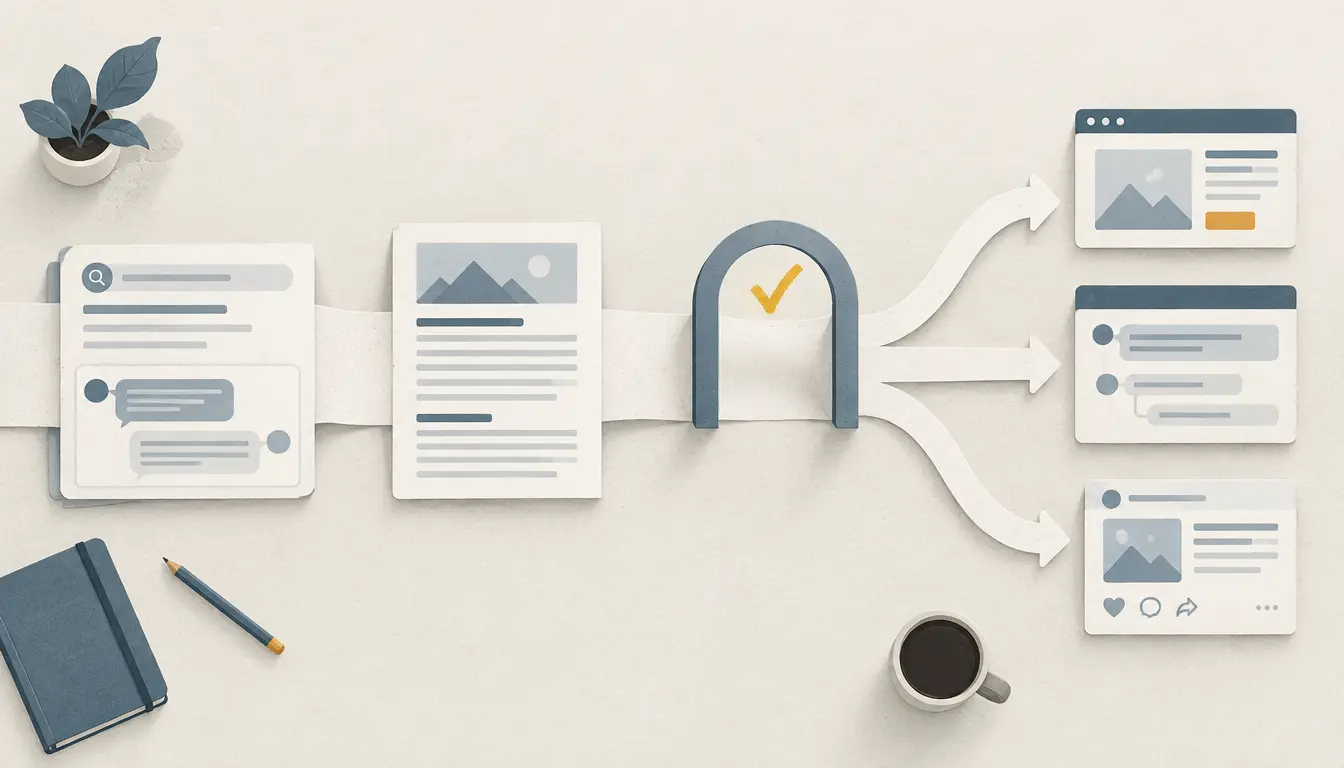
For solo founders and lean teams, this is actually good news. You don't have legacy workflows to unlearn. You can design the system right the first time: product context as the foundation, clean materials as the input, human approval as the governance layer, and publishing as the output.
The question isn't "which AI tool should I use?" It's "what does my marketing operating model look like, and where does AI fit into it?"
Answer that first. The tools will follow.