The AI writing tool market just crossed a threshold that changes the math for solo founders.
Jasper — once the default AI writer for bootstrapped builders — now starts at $59 per seat per month and is explicitly targeting teams and enterprises. Writesonic rebranded as an "AI Search Visibility Platform" at $39 per month, abandoning the solo market entirely. Rytr at $9 per month is the only budget option left standing. Meanwhile, ChatGPT and Claude Pro both sit at $20 per month and do most of what those tools did.
The pattern is clear: specialized AI writing tools can't compete with general-purpose platforms on features, so they're retreating upmarket. Solo founders are collateral damage.
What's left is a real choice between two paths. Here's what each one actually looks like in 2026.
The Fragmented Stack: Death by a Thousand Subscriptions
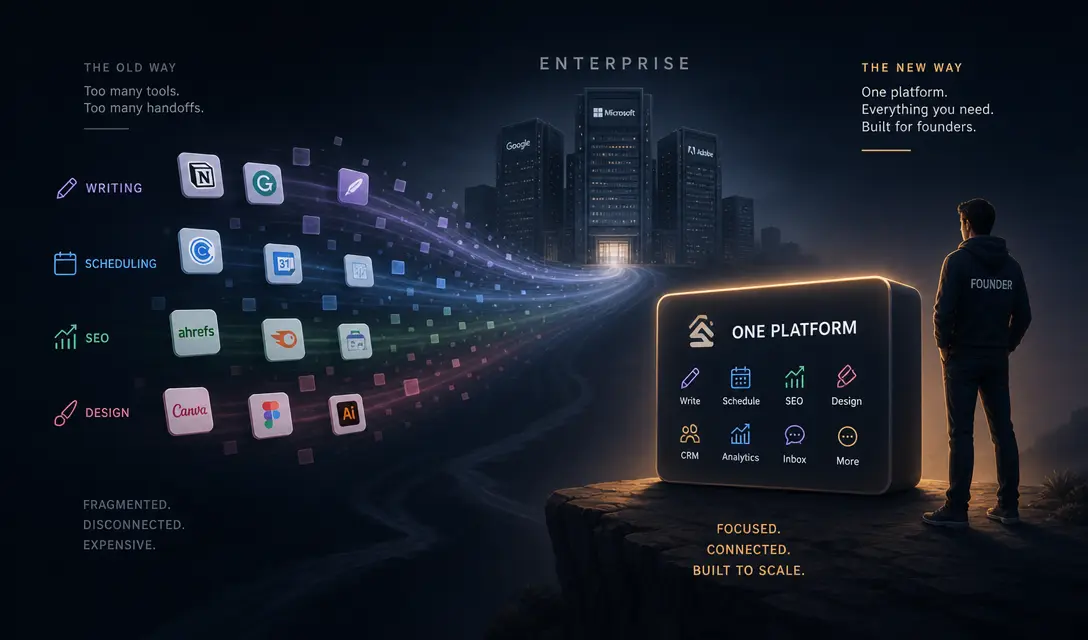
A solo founder trying to run marketing with standalone tools right now is looking at something like this:
- ChatGPT Plus or Claude Pro: $20/month for content generation
- Jasper or Copy.ai: $39–$59/month for marketing-specific templates and brand voice features
- Semrush or Ahrefs: $129–$139/month for keyword research and rank tracking
- Buffer or Hootsuite: $15–$99/month for social scheduling
- Canva Pro: $13/month for visual assets
That's $216–$330 per month before you've touched competitor tracking, community discovery, GEO optimization, or any coordinated strategy. And you're still context-switching between five tools, none of which know anything about your product.
Factors.ai put the problem plainly in a July 2026 analysis: teams end up "running 10 subscriptions, five dashboards, and three separate attribution systems simultaneously" — each individually "affordable" but together creating a "tangled mess of overlapping data, conflicting metrics."
They called it the invisible tax. A $49 tool is often more expensive than a $1,000 platform because it requires manual CRM syncing, data cleanup, and additional supporting subscriptions just to function.
The Consolidation Path: One Platform, One Context
The alternative is running everything through a single platform that holds your product context across every function — instead of re-explaining your product to five different tools every time you sit down to do marketing.
This is the model VibeCom was built for. At $20–$100 per month, it consolidates:
- Content generation — drafts grounded in your product context, brand voice, channel settings, and saved materials, not generic prompts
- SEO and GEO — keyword research, page inventory with search performance data, and recommendations for AI answer surfaces
- Social publishing — channel-native posts for X, LinkedIn, and blog with scheduling and auto-publish
- Competitor tracking — radar that monitors launches, pricing changes, positioning shifts, and content moves
- Community discovery — qualified Reddit and community thread inventory with citable recommendations
- Materials library — a single repository for product updates, customer stories, competitor intel, and market signals that feeds every output
The difference isn't just cost. It's context. Each tool in a fragmented stack starts from zero every session. A consolidated platform builds product knowledge over time — every draft, every SEO recommendation, every competitor alert draws from the same growing understanding of your business.
Why the Market Is Forcing This Choice Now
Three things happened simultaneously in mid-2026 that made the fragmented approach unsustainable for solo founders:
1. Specialized tools priced themselves out. Jasper's move to $59/seat and Writesonic's rebrand are symptoms of a structural shift: standalone writing tools can't compete with $20/month general platforms on features, so they're retreating to enterprise budgets. Solo founders are collateral damage.
2. AI marketing ROI accountability arrived. Jasper's own 2026 State of AI in Marketing found that only 41% of marketers can prove a return on their AI investment. When you're spending $300/month across five tools with no unified reporting, proving ROI — even to yourself — is nearly impossible.
3. The invisible tax crossed a threshold. The coordination cost of managing multiple AI tools — prompt iteration, data cleanup, output review, context switching — now exceeds the tool cost itself. The NBER found that 90% of AI-using firms report zero productivity gain over three years, with tool-switching and output review overhead as the primary explanation.
What This Means If You're Running Marketing Alone
If you're a solo founder on a fragmented stack, the math is changing under your feet. The tools you relied on are moving upmarket or being absorbed by general-purpose platforms that don't know your product.
Three options:
Stay fragmented and absorb the rising cost. Accept that your stack will run $250–$400/month and require constant context switching. Viable if you have the budget and don't mind the overhead.
Go all-in on general-purpose AI. Use ChatGPT or Claude for everything — content, research, strategy. You'll save money but spend more time prompting, correcting, and feeding context that doesn't persist between sessions.
Consolidate on a platform built for this. Move to a single system that holds your product context, brand voice, materials, and channel settings — and generates everything from that foundation.
The right answer depends on your stage. But the market is making one thing clear: the era of the affordable, fragmented AI marketing stack is ending. The tools that served solo founders are moving on. The ones staying are consolidating.
Choose accordingly.