An AI SEO agent is worth paying for when it turns a keyword you chose into an article you can read, edit, and publish on your own site. Everything before that point is research, and everything after it is a URL you can check. Google Search Central sets the bar for the rest of the category in two sentences: using a tool "doesn't guarantee ranking success," and because third-party tools have no access to Google's ranking data, they "can't guarantee performance."
What the demand for AI SEO tools actually looks like
The category's own marketing rarely shows the numbers, so start with ours. Keyword research for this site (DataForSEO, US and English, retrieved 27 September 2026) puts "ai seo tool" at 2,400 searches a month with a difficulty of 26. The page currently ranking first for it carries 698 referring domains. The plural, "ai seo tools," is reported at the same 2,400 searches, which makes it one demand spelled two ways rather than two audiences to add together.
"seo automation" looks smaller at 1,900 searches a month, but its difficulty is 14 and the page in the top spot holds it with roughly 39 referring domains. Between those two sit "ai seo software" (390 searches, difficulty 42) and "ai powered seo" (210, difficulty 24).
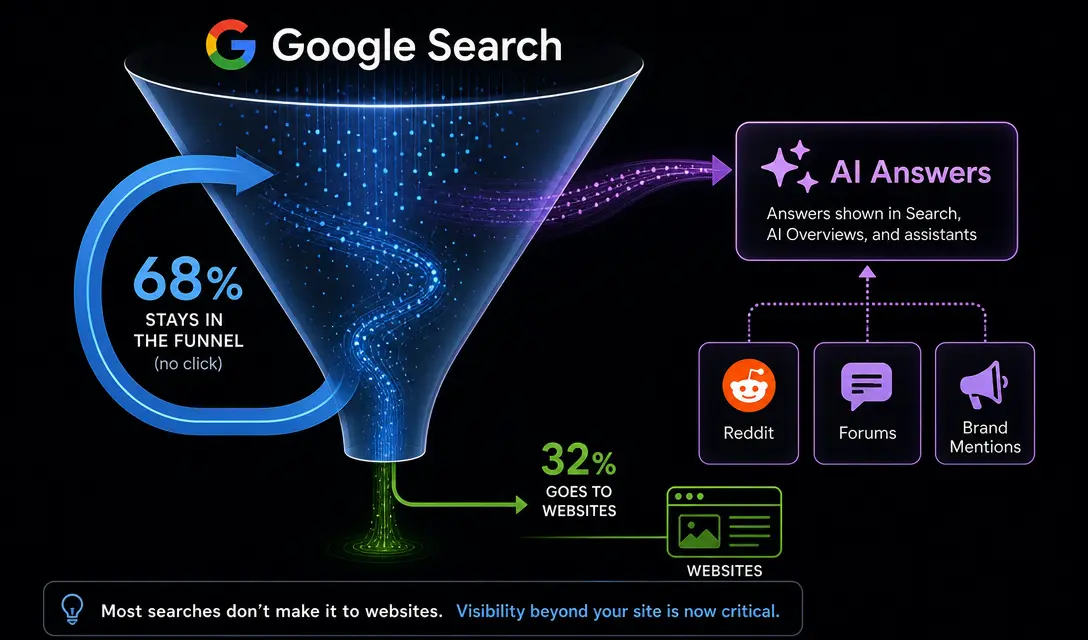
Every term in the group is also down year over year: "ai seo tool" by 46%, "seo automation" by 47%, "ai powered seo" by 57%, "ai seo software" roughly flat. The likeliest reading is that the question moved into the answer box. Pew Research studied 68,879 Google searches and found that 60% of queries beginning with a question word produced an AI summary, and that a click inside that summary happened in 1% of the visits where one appeared. A question about which tool to buy is exactly the kind that now gets answered above the results. The study ran in March 2025 and cannot prove anything about this one term, but it fits the shape of the volume data.
None of which means search optimization is over. Google's guide to generative AI search answers the relevance question with "In short, yes!" The AI features sit on the same index and ranking systems, using retrieval-augmented generation to pull pages in and query fan-out to expand one question into several related searches. Getting into that pool is still ordinary SEO work.
Four checkpoints between a keyword and a published page
AI SEO tools look identical in a demo. The fastest way to see the difference is to hand one of them a keyword of your own and watch where it stops: at a list, at an outline, or at a draft with a destination. What separates the products is how many of these four outputs you can actually hold.
A keyword with its evidence attached. Volume, difficulty, intent, and an argument for why this term fits your product. RiseMore's SEO agent reports keywords with all three data points, and inspecting existing keyword data is available on the Free plan; the agent that generates and submits articles runs on the paid tiers.
A complete draft rather than a brief. An outline is the cheap half of the work, and a recommendation is not a published answer. Google's guidance is more demanding here than most AI SEO software: content that "simply restates information already available elsewhere" is the thing its systems discount, so a unique point of view is doing real work inside the draft.
A destination you control. On your own domain, submitted to the site you connected, so the URL, the internal links and the history stay yours. RiseMore publishes to the connected site and does not silently rewrite pages you already have. It also does not promise that the page gets indexed or ranks, because nobody can.
A record you can check afterwards. Rankings tracked after publication, plus a first-party look at how the page surfaces in AI features. Search Console's Generative AI performance report is the only measurement of that second part made by the company running the search engine, and Google's own tool guidance recommends it over anything a third party infers.
A product that can't show you all four is not publishing anything. It is selling research, which is a legitimate purchase as long as you know the article still has to be written by someone. For a solo founder, that someone is usually the constraint the purchase was meant to remove.
What Google's guidance says to ignore
A surprising amount of what AI-powered SEO products sell appears on Google's own list of things you don't need. Its generative AI guide, updated 10 July 2026, groups them as misconceptions:
- LLMS.txt files and other special markup, because "Google Search itself doesn't use them."
- Chunking content into small pieces so a model can understand it.
- Rewriting existing pages in a particular style just for AI systems.
- Chasing inauthentic mentions across the web.
- Adding structured data beyond the schema you would use anyway.
That list works as a filter: if a product's main pitch is one of those five, it is selling a workaround Google says its systems don't use. The guide also names the failure that volume-first pipelines walk into. Generating separate content for every variation of a query "primarily to manipulate rankings or generative AI responses" falls under Google's scaled content abuse policy, and, in the guide's words, "a high quantity of pages doesn't make a website higher quality or more relevant to users." A tool that quotes you a page per keyword is quoting pages that policy treats as spam.
What AI-powered SEO still doesn't fix
Three limits matter, and they tend to arrive in this order.
Ranking is not on the menu. Google says so twice on one page: no guarantee of ranking success, and no access to its internal ranking data. A term at difficulty 26 with 698 referring domains on the top result is a target measured in months, and one article rarely takes it.
Technical eligibility has to be true before any of this works. A page must be indexed and eligible to show a snippet before it can appear in AI features at all. If your site blocks crawling, renders content only after a JavaScript error, or still carries a noindex tag from a staging deploy, a writing agent will keep producing pages that cannot show up. That repair is a different job, and RiseMore does not do it.
Traffic is a separate promise from visibility. Pew's comparison is the number worth keeping: users clicked a traditional result in 8% of visits with an AI summary present, against 15% without one. A mention in an AI answer is not a visit. RiseMore's GEO reporting makes the same distinction, measuring AI visibility as the share of valid observations that mention your product rather than as traffic or conversions.
The worked choice: which keyword gets the first article
Set the two largest terms side by side and the decision makes itself. "ai seo tool" is the bigger prize at 2,400 searches a month, but 698 referring domains already sit on the top result. "seo automation" is nearly as large at 1,900, at difficulty 14, with about 39. With one article's worth of effort and a young domain, the second is the one with a chance of being seen this quarter; the first is a target you chip at over a year.
Whichever you choose, the article has one shape: answer the query in the first two sentences, take a position the other results don't, and skip the page-per-variation habit the scaled content policy describes. A page split into thin sections covering every phrasing of the question is the thing Google's systems are built to discount.
This page is the worked example. It uses our own keyword data rather than a remembered statistic, links to the primary sources behind its claims, and says where its own reach ends.
Before anything publishes, there is one test worth keeping: can you read the draft and name the URL it will live at? A tool that passes that is doing the work you needed done. A tool that hands you a schedule and a pile of keyword ideas has finished the research, and the writing, which was the part you were trying to buy your way out of, is still in front of you.